
Criminal Court Cases in Scotts Bluff County
Scotts Bluff County uses two trial courts in the same courthouse at 1725 10th Street in Gering. County Court, on the first level, hears misdemeanors, infractions, traffic and extradition matters, city-ordinance complaints, and felony preliminary hearings. District Court, on the second level, is the felony trial court. A felony may therefore leave an early County Court matter and a later District Court case. Search both levels when the charge began with a preliminary hearing or when a single result seems incomplete.
The clerk at each level keeps that court's filings, register of actions, judgments, and public images. Scottsbluff, Gering, and Mitchell do not have separate municipal court databases. Under Nebraska law, city and village attorneys file ordinance complaints in County Court. That point matters because a search limited to an imagined city court will miss the actual file. The official Scotts Bluff County Court page shows the lower court's location, hours, jurisdiction, and contact details.
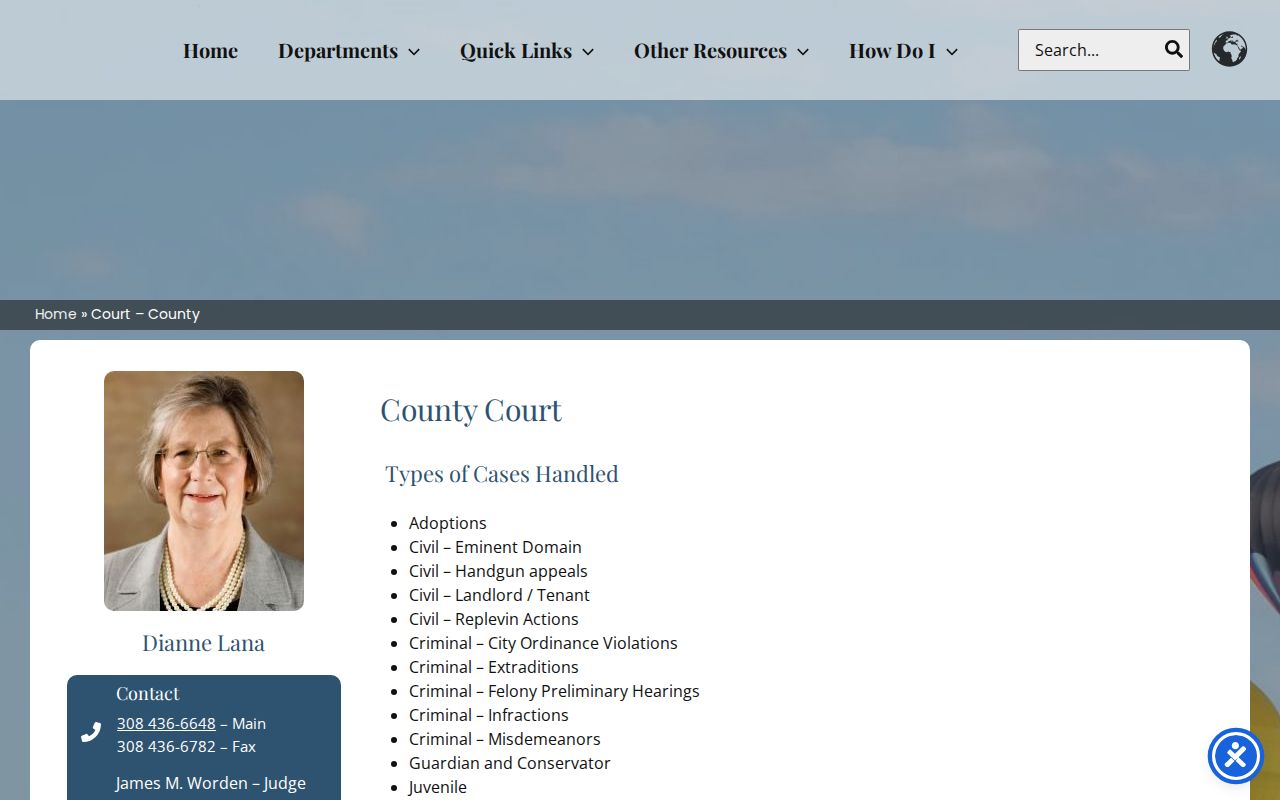
The county page confirms that the first-level office is the right local contact for misdemeanor, ordinance, and preliminary-hearing case files.
Scotts Bluff County Courts by Charge
A filed charge, not the arresting agency's label, determines the court record that follows. The County Attorney may decline, amend, add, or consolidate charges after an arrest. A received jail charge can thus differ from the complaint, information, or final count on the docket. For a full sequence, note the court, case number, filing date, and status shown on each result rather than treating each entry as the same record.
Scotts Bluff County Court
1725 10th Street, Level 1
Gering, NE 69341
308-436-6648
Monday through Friday, 7:30 a.m. to 4:30 p.m.
Use for misdemeanors, infractions, ordinance complaints, and felony preliminary matters.
Scotts Bluff District Court
1725 10th Street, Level 2
Gering, NE 69341
308-436-6641
Monday through Friday, 8 a.m. to 4:30 p.m.
Use for felony filings, judgments, appeals, and certified copies from the district file.
Both offices remain open through lunch. Courthouse entry is screened, so allow time for the magnetometer and call the destination clerk before bringing recording gear or arranging a specific accommodation.
Scotts Bluff County Case Record Searches
JUSTICE One-Time Search is the main remote channel for Nebraska trial-court cases. The service can lag court activity by about 24 hours, returns no more than 30 cases, and keeps one-time results available for three calendar days. Its displayed price has differed from older Judicial Branch descriptions, so check the live amount before paying. A fee can apply even when the search returns no record.
- Accept the JUSTICE terms and select Begin Search.
- Enter the party's last name first. Do not search a witness as though that person were a case party.
- Add Scotts Bluff County, County or District Court, the likely year, or CR case type one filter at a time.
- Open the result and read its status, filed offenses, costs, register of actions, and available public images.
- Use the matching clerk for an identified older file, mailed copy, or certified court document.
The free courthouse terminal is the best fallback for a broad party-name or case-number search. Clerk staff can help locate an identified matter when given a full party name, approximate year and type, or, best of all, a case number. Staff do not conduct open-ended research and will not certify that no record exists. Frequent users may instead open a Nebraska.gov subscriber account, currently listed at $100 annually for up to ten users. General result-list searches are free within that service, while opening a case or searching by case number or judgment date is $1.
Building a Scotts Bluff County Case Search
The official JUSTICE demonstration shows why a broad first pass works well. Last name alone is accepted. County, court level, year, type, judge, and attorney are filters, not facts that must all be known in advance. Too many early filters can hide the very case being sought.
| JUSTICE field | Type | Required | Use |
|---|---|---|---|
| Party Name | Text | Effective starting field | Last name alone is accepted |
| Party Type | Radio | Yes | Choose Individual or Entity |
| County | Multi-select | No | Select Scotts Bluff when narrowing |
| Case Year | Select | No | Add an approximate filing year |
| Court Type | Select | No | County or District |
| Case Type | Multi-select | No | CR identifies criminal cases |
| Judge or Attorney | Multi-select | No | Best used after a broad result |
| Sort and Client Memo | Select or text | No | Controls display and invoice note |
Typing can jump through long multi-select lists in the official case-search demonstration. The controls may feel cramped on a phone, so a desktop can be easier. Save the receipt details and download wanted results during the three-day access window.
What a Criminal Case File Contains
A Scotts Bluff County court file records what was filed and what the judge did. It is not the Sheriff's incident narrative, a Detention Center booking entry, or the Nebraska State Patrol RAP. That distinction protects against a common error: treating an accusation or received jail charge as the court's final outcome. Read the filed offense with the register of actions and disposition.
| Case Number and Court | Identifies the specific County Court or District Court matter and its case type. |
|---|---|
| Parties and Attorneys | Lists public party roles and counsel associated with the filed case. |
| Filed Offense | Shows the charge description, classification, and statute when entered. |
| Register of Actions | Provides dated docket events, hearings, motions, orders, pleas, and other entries. |
| Costs and Judgments | May show sums assessed, paid, or still due on the case ledger. |
| Disposition and Sentence | Records dismissal, acquittal, conviction, other outcome, and the sentence imposed. |
| Public Images | Includes available nonconfidential filed or uploaded documents from the covered period. |
Victim information, minor data, sealed matters, and other confidential material may be omitted or redacted. A docket event is still a court fact at a point in time, not proof that every agency database has already received the same update.
Scotts Bluff County Court Name Traps
A middle initial can make a Scotts Bluff County lookup worse. Start with the last name, then add the first name only when the result list is too broad. Try plausible variants before deciding a case is absent. The system caps results at 30, so use the county, likely court level, and year in small steps instead of applying every possible field at once.
A citation or police contact may never become a filed criminal case. The reverse problem also occurs: one felony episode may appear first in County Court and later in District Court. Compare court levels, dates, and case numbers. For a recent arrest that has not reached JUSTICE, current custody belongs with the county portal or Booking line. The distinct agency and jail sources are covered by the Scotts Bluff County arrest search.
Note: A blank JUSTICE result describes that search at that time; it does not certify that no police, jail, sealed, or archived record exists.
Criminal Case Stages in Scotts Bluff County
A Scotts Bluff County case file grows as the prosecution advances. The charging document states the accusation. Arraignment records the plea. Pretrial entries can reflect scheduling, motions, discovery disputes, or negotiations. A plea or trial creates the path to disposition. If guilt is entered, the sentence becomes a separate court act and may include custody, probation, costs, or restitution as authorized in that matter.
Case flow: Charges Filed → Arraignment → Pretrial → Plea or Trial → Disposition → Sentencing
The register of actions is the dated index to those events. A complaint is an initial sworn accusation. An information is the prosecutor's formal charge. Disposition means the court's outcome, such as dismissal, acquittal, or conviction. These terms should be read in sequence because an early charge does not answer how the matter ended.
Scotts Bluff County Court Images
Since a January 2024 enhancement, one-time JUSTICE results can include available nonconfidential images filed or uploaded after April 16, 2008 without a separate image charge. Availability is not the same as completeness. Older files may be paper, archived, or only partly imaged, while protected documents remain unavailable to the public. The Scotts Bluff District Court page identifies the clerk's record duties and the local counter for felony files.
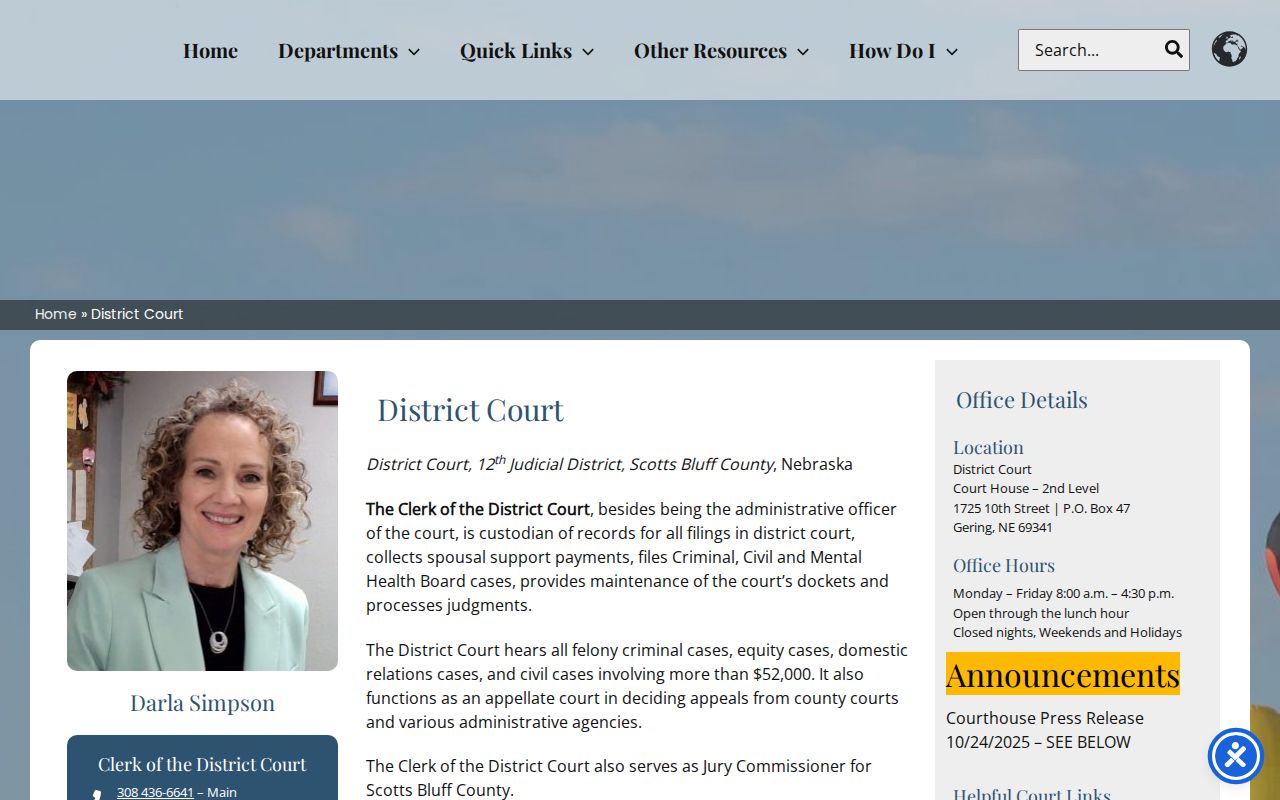
That clerk is the practical source for a specifically identified District Court copy when an image does not appear online.
The Nebraska Judicial Branch also maintains a Scotts Bluff District Court directory with the current court listing.
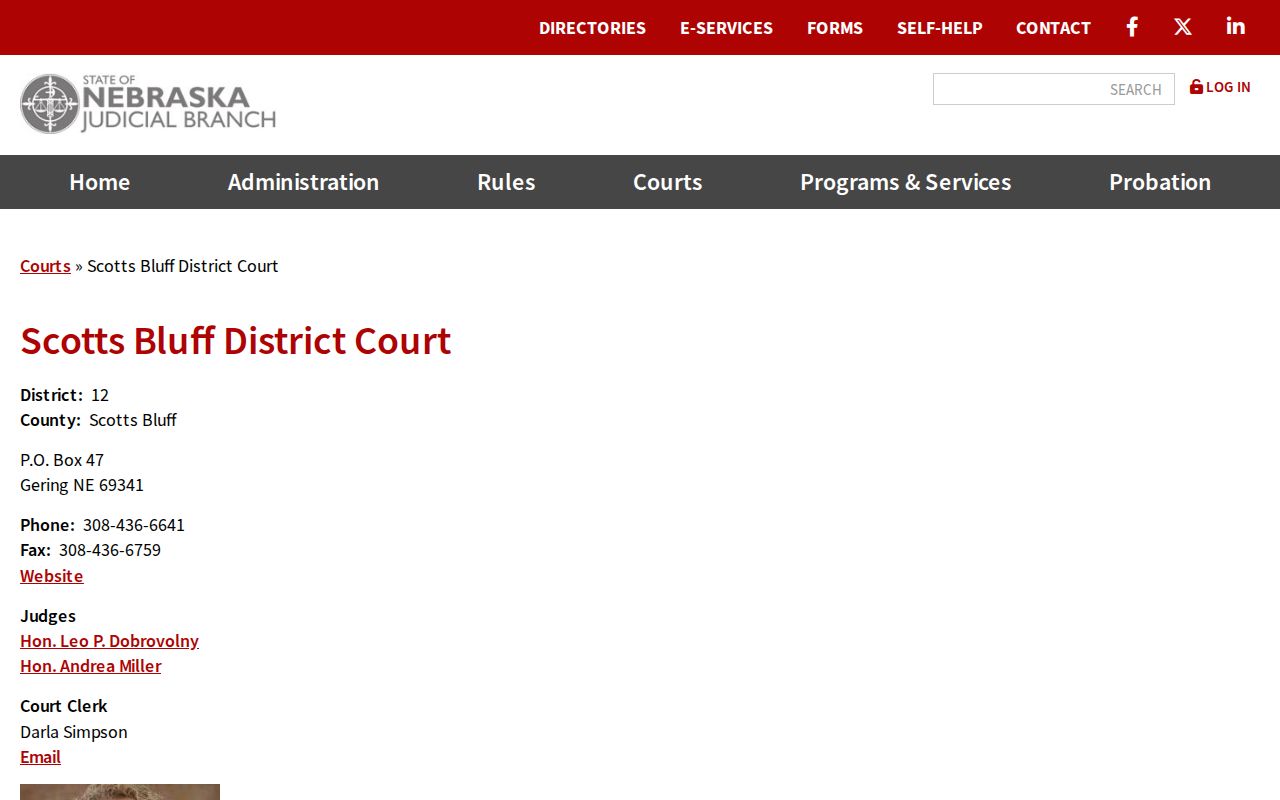
The state directory is useful for confirming the court office before seeking an old file, accommodation, or official copy.
Scotts Bluff County Case Assignments
Local Rule 12-11 randomly assigns new Scotts Bluff County matters. A reopened case returns to the original judge, and the two judges alternate monthly jury terms. Judge is therefore a useful filter after a result has been narrowed, but it is not a sound first assumption. A party may not know which judge received a new filing, and selecting the wrong name can suppress the correct result.
The Judicial Branch County Court directory provides the official state listing for the lower court.
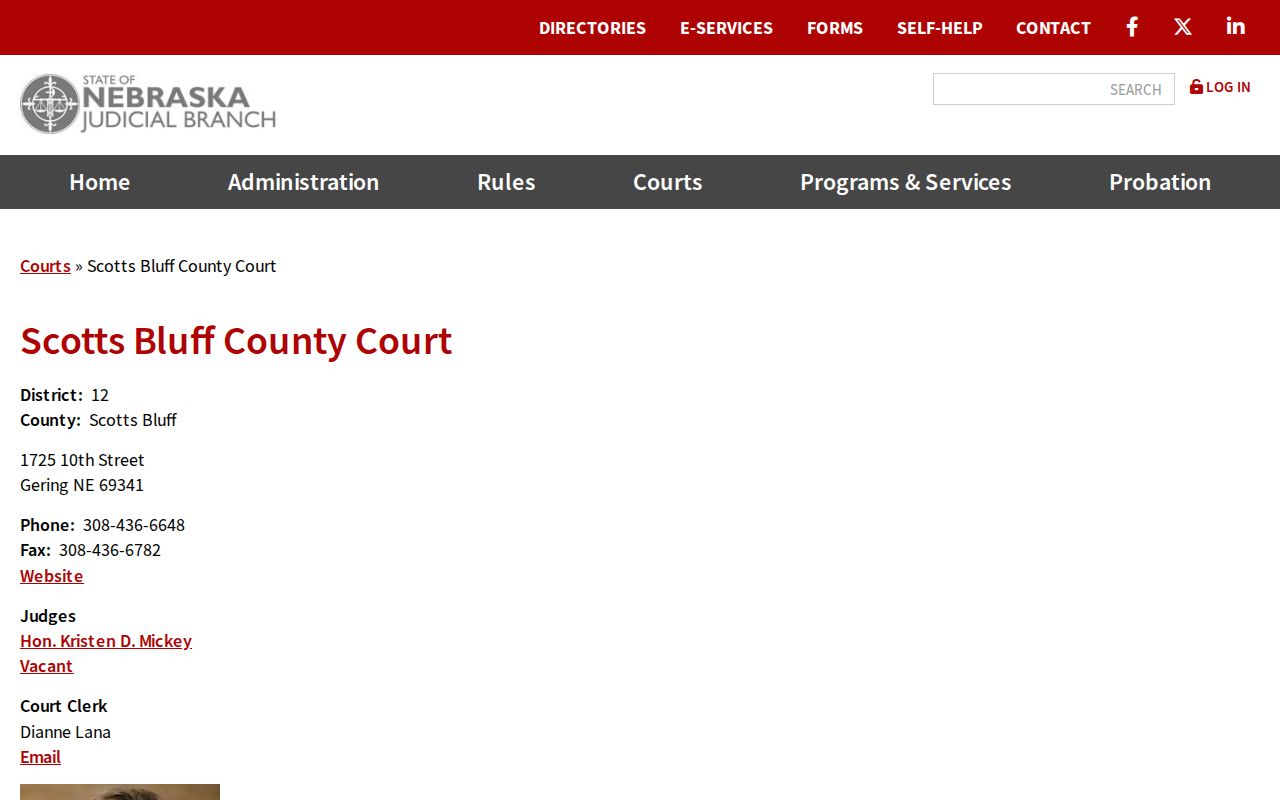
Together, the state directory and local page help distinguish the County Court clerk from the District Court clerk before a copy request is sent.
Access Rules for Case Records
Nebraska court records are generally open unless a statute, court rule, or order restricts them. Juvenile cases, sealed matters, protected victim or minor information, and confidential filings may not appear in a public search. Redaction masks protected content while leaving a releasable part available. A sealed record is withheld under law or court order, so absence from JUSTICE does not prove the underlying event never occurred.
Use the clerk for routine case copies, certification, a free courthouse terminal search, or an identified older file. In-person and mailed requests remain available. A nonstandard court-administration record may call for a request under the Nebraska Public Records Statutes, but that route does not replace the clerk's normal case-file process. Nebraska law permits inspection and copying of nonexempt public records during office hours at lawful actual cost.
Keep the records distinct. JUSTICE holds the court case. The arresting agency holds its report, the jail holds booking data, and the Nebraska State Patrol holds the fingerprint-supported RAP.
For an old file, give the clerk the full party name, approximate year, case type, and case number if known. Ask whether the record is paper, archived, or imaged, and whether a plain screen print or certified copy fits the need. Broader county criminal-history channels are described on the Scotts Bluff County records overview.